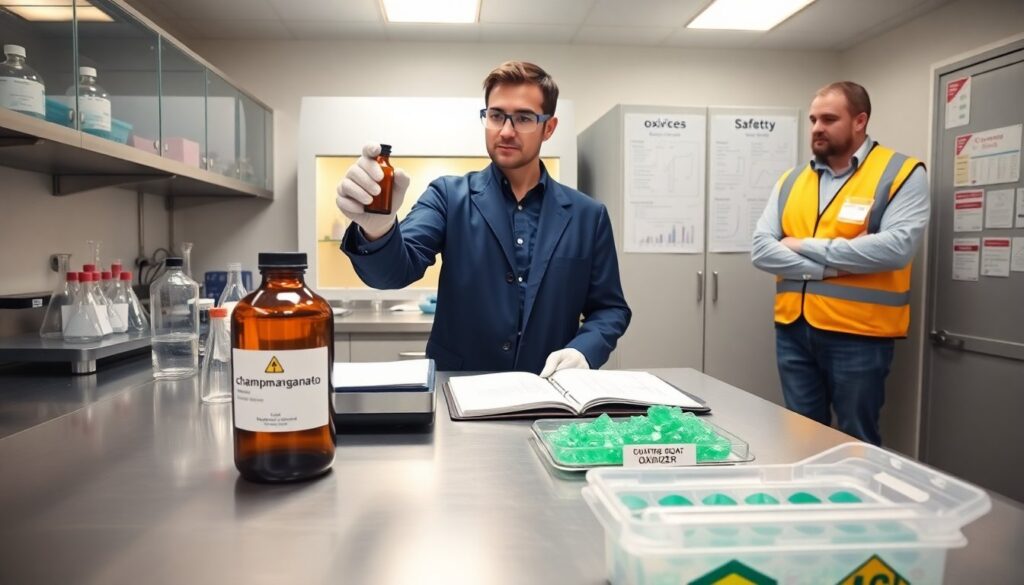

Champmanganato is a manganese oxo compound used in labs and industry. It acts as an oxidizer in organic reactions and as a precursor to manganese salts. Chemists use it for selective oxidations and for teaching redox concepts. Safety officers treat it as a hazardous oxidizer. This article lists identity, properties, uses, handling, and first aid in clear, direct terms.
Table of Contents
ToggleKey Takeaways
- Champmanganato is a manganese oxo compound used primarily as an oxidizer in organic reactions and industrial effluent treatment.
- It features manganese in a +6 oxidation state within tetrahedral MnO4 units, giving it strong oxidation potential and characteristic green solutions in basic media.
- Chemists use champmanganato for selective oxidations, redox teaching, and as a standard oxidant in titrations and analytical methods requiring rapid electron transfer.
- Safe handling requires storage in cool, dry conditions away from organics and acids, along with proper PPE and training to manage oxidizer hazards effectively.
- Emergency response for exposure includes thorough water flushing, medical evaluation for chemical burns, and adherence to protocols for oxidizer injuries and hazardous waste disposal.
- Before disposal, residual champmanganato must be neutralized by reducing agents to convert it into nonreactive manganese salts following regulatory guidelines.
What Champmanganato Is: Chemical Identity, Structure, And Common Names
Champmanganato is a manganese-based compound that contains manganate anions. Chemists call it by systematic names when they describe its stoichiometry and oxidation states. It often appears as a green or dark crystal, depending on hydration. Vendors list common names, including manganate(VI) salts and related trade names. Its core ion shows manganese in a +6 oxidation state bonded to oxygen. The structure centers on tetrahedral MnO4 units that link with counterions. Analysts confirm the identity by IR spectra, UV-visible bands, and mass signals. The compound forms stable salts with alkali or ammonium cations under dry conditions. It changes color or decomposes when strong acid or heat contacts it. Laboratories log the chemical by CAS numbers and by its common name to avoid confusion. Researchers treat the name champmanganato as shorthand in lab notes and sample labels.
Physical And Chemical Properties Plus Typical Laboratory And Industrial Uses
Champmanganato shows a high oxidation potential. It oxidizes alcohols, alkenes, and some sulfides under controlled conditions. It dissolves in basic water to give green solutions with characteristic UV-visible peaks. It reduces to manganese dioxide or lower oxidation states when it reacts with strong reductants. It melts or decomposes at moderate heat and can release oxygen during breakdown. In the lab, technicians use champmanganato as an oxidant for preparative reactions and for small-scale syntheses. In industry, processors use it to treat effluent streams that need oxidation of organic contaminants. Teachers use it for demonstrations of color change and redox stoichiometry. Quality control teams use it as a standard oxidant in titrations that require a known redox agent. Analytical chemists use it in methods that require rapid electron transfer. Manufacturers produce champmanganato salts with varying cations to tune solubility and reactivity. Users must plan reactions to avoid excess heat and to control pH. They must also design quench steps to convert leftover oxidant to nonreactive manganese salts before disposal.
Handling, Safety, And Disposal Best Practices
Facilities store champmanganato in a cool, dry cabinet away from organics and acids. Staff label containers with content, concentration, and hazard data. They keep material in airtight, non-reactive containers and avoid metal tools that spark. Workers wear splash goggles, gloves, and protective clothing when they measure or transfer it. They use fume hoods for operations that release dust or vapors. They control spills with inert absorbents and sweep material into sealed containers for disposal. They do not mix champmanganato with reducers or with strong acids in storage. Safety officers provide training on oxidizer hazards and on proper PPE. Waste handlers neutralize residual oxidant with measured reducing agents under controlled conditions. They then precipitate manganese as manganese dioxide or convert it to stable manganese(II) salts for regulated disposal. Facilities follow local and national rules for hazardous waste transport and disposal. They keep records of waste manifests and disposal routes for audits. Emergency drills include oxidizer spill scenarios and simulated cleanups.
Emergency Response And First Aid For Exposure
If skin contacts champmanganato, workers flush the area with water for at least 15 minutes. They remove contaminated clothing and seek medical care for burns or persistent irritation. If eye contact occurs, responders hold eyelids open and flush with water for 15 minutes while calling emergency services. If someone inhales dust, they move the person to fresh air and monitor breathing. If ingestion happens, responders do not induce vomiting and they contact poison control immediately. First responders treat suspected oxidation burns as chemical burns and they monitor for respiratory distress. Emergency teams secure the area and ventilate if needed. They collect material samples for lab analysis to guide treatment. They notify local authorities when a spill reaches storm drains or public areas. They document the incident, exposures, and treatments for later review. Health staff advise medical providers to consider manganese exposure and to follow established protocols for oxidizer injuries.